


Hospital-Discharge-Education-for-Heart-Failure-Patients-Delivered-by-Conversational-Agent-Technology
Using conversational agent technology for hospital discharge education in heart failure patients enhances patient experience and is favored over traditional doctor or nurse interactions.
Abbas Mohammadi, Jamie Barney, Sultana Jahan, Deepu Rathi, Vipin Chengat, Henry Hodder, Brian Jack, Leo Spaccavento, Hossein Akhondi
Introduction.
The hospital discharge process is non-standardized and contributes to post-discharge adverse events, rehospitalization and high cost. To address this, we developed the Re-Engineered Discharge (RED) program designed to provide high quality discharge education, shown to lower readmission rates and improve patient satisfaction. Integrating digital technologies could facilitate its implementation into hospital workflow.
Research Question.
Do hospitalized heart failure (HF) patients find it acceptable to receive their discharge education from
MayaRED?
Methods:
We designed “MayaRED”, a digital conversational agent that simulates face-to-face human interactions through personalized, conversational dialogue to deliver discharge education. MayaRED employs the “teach-back” method to document patient understanding. Upon completion, a report documents what was taught by MayaRED and understood by the patient. Participants were asked to complete a survey regarding their perceptions of the acceptability and usefulness of MayaRED.
Participants were matched to controls subjects to evaluate the comparative effectiveness.
Results.
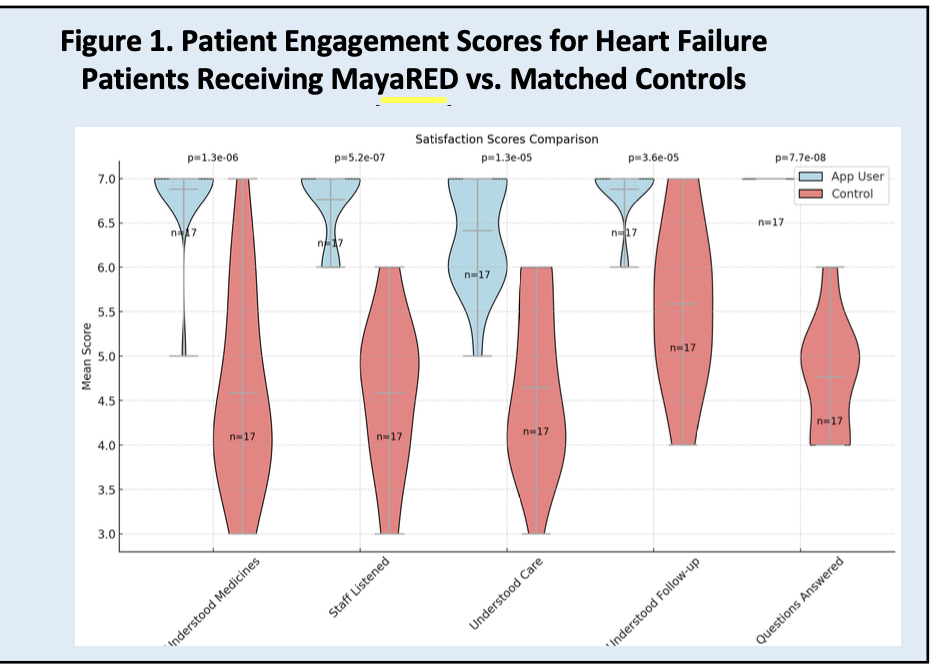
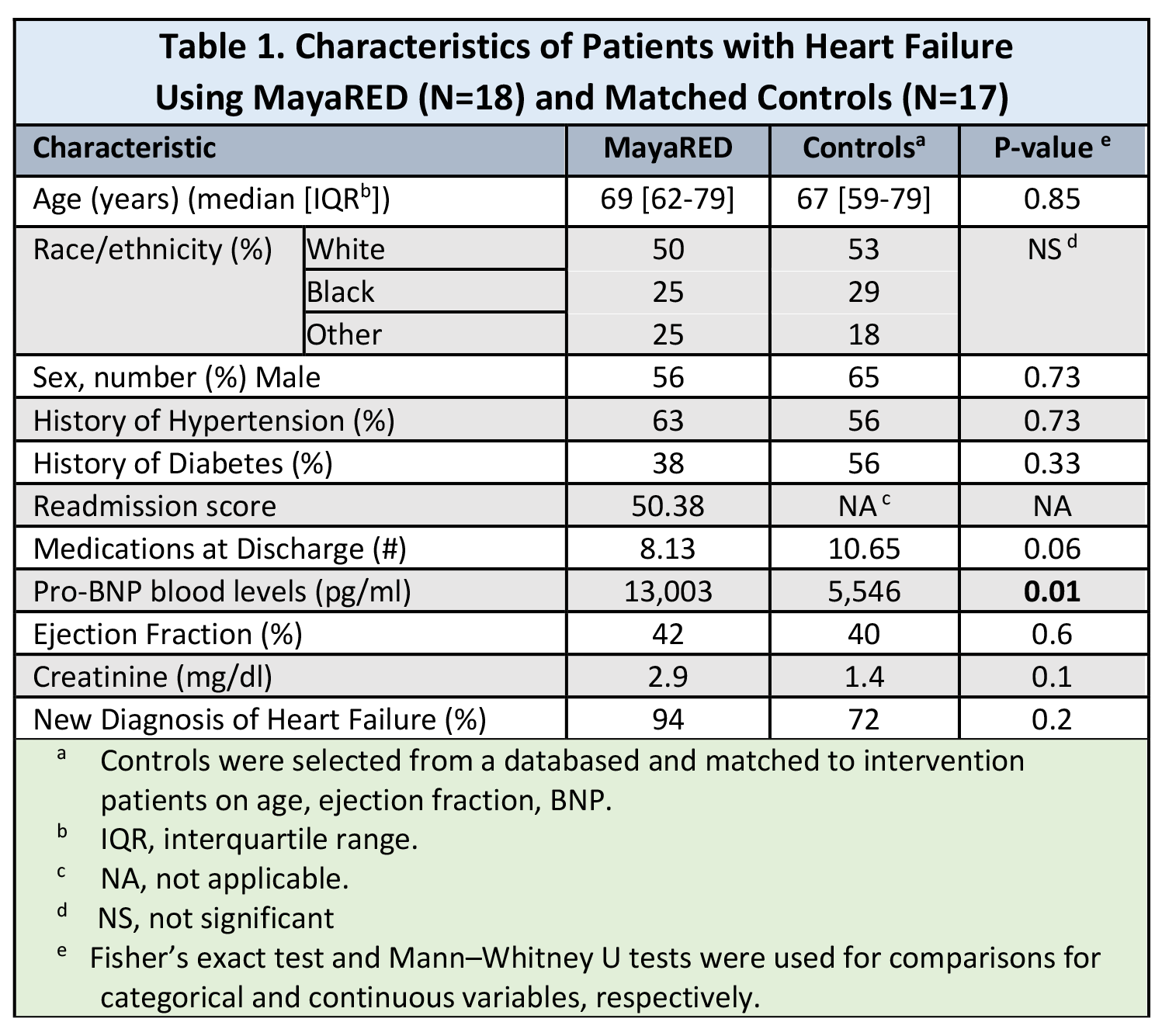
HF patients (N=18) using MayaRED averaged 69 years, 13,003 pg/ml pro-BNP, 42% ejection fraction and 3 mg/dl creatinine were compared to 17 matched controls. On a 1 to 7 point Likert scale (1=strongly disagree; 7=strongly agree), patients using MayaRED reported that they had “their questions answered” (mean 6.47 vs. 4.76; P<.0001), “understood their follow-up appointments” (6.73 vs. 5.59; P<.0001), “understood their medicines” (6.87 vs 4.59; P<.0001), and understood “how to care for themselves at home” (6.07 vs 4.65; P<.0001) (Figure 1). Intervention patients reported that they trust MayaRED (6.80), “are likely to follow Maya’s advice” (6.66), and are “confident in Maya’s ability to help me” (6.66). When asked “If you were hospitalized again at SVH, would you like to interact with Maya again?,” all patients responded “yes”. When asked “would you rather have the nurse/doctor or Maya give you your information about your discharge, all 18 responded MayaRED (Figure 2). Preliminary data show
the 30 day all-cause readmission rate for those receiving MayaRED was 16.6% vs 29% for controls.
Conclusion.
The MayaRED conversational agent system is well-accepted by HF patients, demonstrating its feasibility as a tool for delivering discharge education. These findings support the continued implementation and rigorous testing of MayaRED in diverse clinical settings.
About MayaMD
MayaMD Inc. was founded by Vipindas Chengat, MD FACP to reduce the prevalence of diagnosis and human cognitive error. MayaMD builds tools to quickly deliver the most relevant health and medical information to the consumer, patient, clinician and student so that diagnoses, treatment, learning and collaboration are timely, effective and affordable.
MayaMD believes that regardless of who you are or where you live or how much money you have, you should have rapid access to the best healthcare information and medical advice in the world.For more information about MayaMD and their MayaMD Health Assistant (for consumers and patients), MayaPRO (for clinicians), MayaEDU (for clinician students) and MayaMD Coronavirus (for everyone) apps, please visit www.mayamd.ai or the iTunes or Google Play app stores.